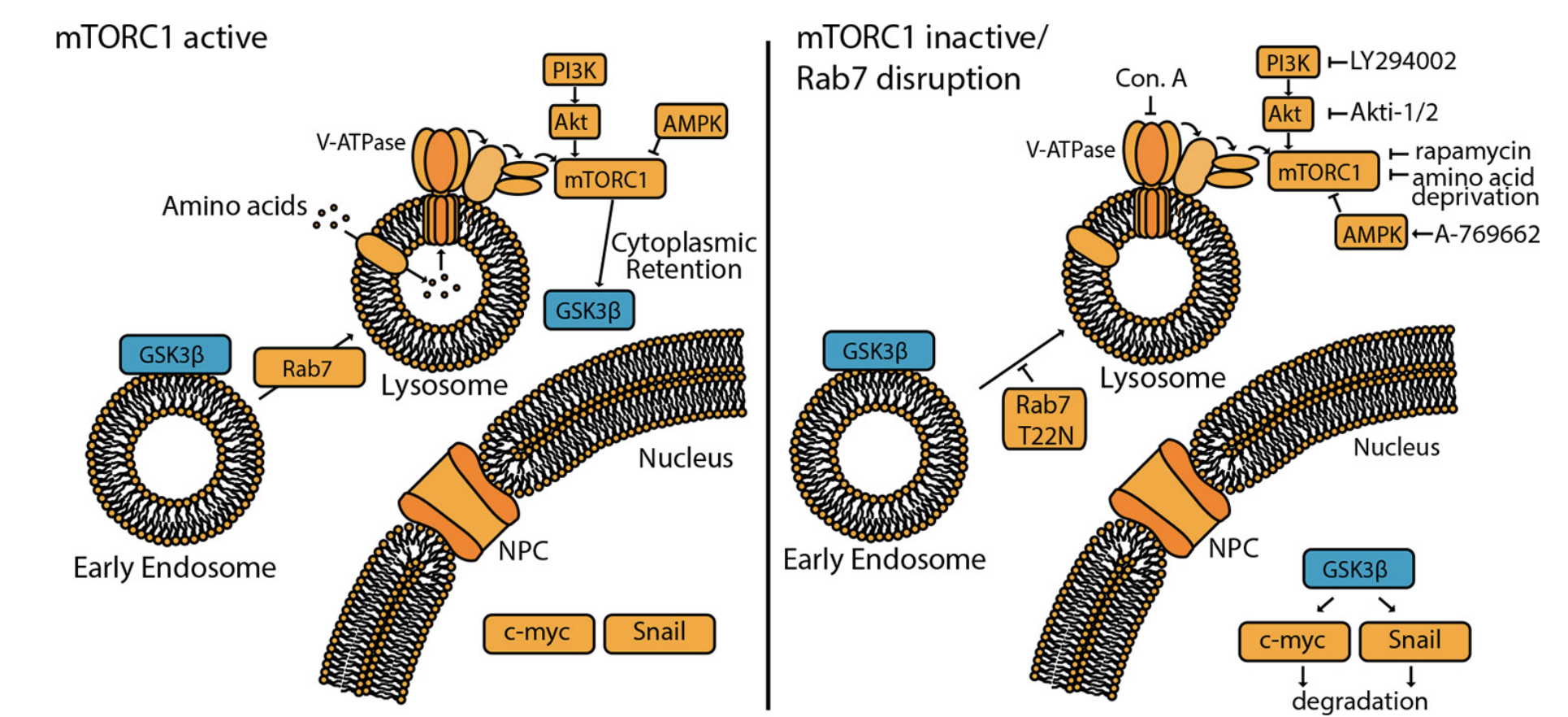
In all organs and tissues, cell behaviour is controlled by the availability of nutrients required for a cell's metabolic needs. Cells use nutrients such as glucose, amino acids, nucleotides and lipids to generate ATP and for biosynthesis of complex macromolecules required for cell proliferation. Cells must coordinate behaviours such as migration, proliferation, and differentiation to nutrient availability. To this end, cells have signaling molecules that are activated in response to nutrient availability or scarcity, including AMP-activated protein kinase (AMPK) and mechanistic target of rapamycin (mTORC1).
How do cells trigger adaptation after specific nutrient conditions are sensed? We focus on studying how these metabolic signals impact organelle dynamics and cellular compartmentalization. We have two major projects in this area:
Current Projects
a) Studying how nutrient signals regulate glycogen synthase kinase 3 (GSK3)
GSK3 is an important kinase that has over 100 known substrates. Importantly, GSK3 is constitutively active, and only partly inactivated as a result of signals that lead to its phosphorylation. Instead, GSK3 relies on robust control of its localization to control its function. We and others have identified that regulation of the nucleocytoplasmic shuttling of GSK3 restricts access to either a nuclear program (which regulates expression of transcription factors such as c-myc) or a cytosolic program. We revealed that nutrient signals involving amino acid sensor proteins such as GATOR complex at the lysosome and lysosomal dynamics regulate GSK3 nucleocytoplasmic shuttling and thus access to nuclear and cytosolic programs (Bautista et al. JBC 2018; Schwendener-Forkel BioRxiv 2024). We are now focused on understanding the molecular mechanisms that allow amino acid signals to control GSK3 spatial organization, and how this impacts breast cancer cell physiology.
b) Studying how nutrient signals remodel early endosomes
Early endosomes serve as critical sorting hubs for material taken up by endocytosis, as well as important platforms for signaling. One of the well-known functions of early endosomes is to ensure the appropriate transit of internalized transferrin receptor and transfer of iron into cells to support iron-dependent functions. We made an important discovery that AMPK, activated in response to nutrient scarcity, reorganizes early endosomes by promoting their redistribution from the cell periphery to the perinuclear region (Mehrabi et al. BioRxiv 2025). Using advanced microscopy and organelle proteomics, we aim to understand the molecular mechanisms that allow remodeling of early endosomes by AMPK and metabolic signals, and the impact of this phenomenon on early endosome function and cell physiology.